
Going to school at Juilliard, music majors were constantly surrounded by dancers and actors in the cafeteria and hallways. I remember how easy it was to distinguish the dancers from the musicians — and not just because of their lean limbs. The dancers always carried themselves with a kind of effortless, upright posture that seemed almost second nature. It made me wonder: what do dancers know about the body that string players don’t?
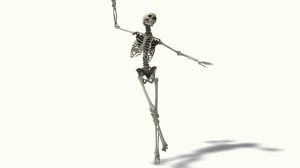
Learning from the skeleton — understanding how the body is designed to move efficiently.
Dancers couldn’t possibly do what they do on stage if they hadn’t been trained to use their bodies as efficiently and naturally as possible. Their craft is built on moving with ease, efficiency, and beauty — maximizing the potential of every movement while minimizing unnecessary effort. Sure, I may never wear pointe shoes or a tutu, but if a dancer’s entire training is oriented around moving the body optimally, there are lessons there for the string player as well.
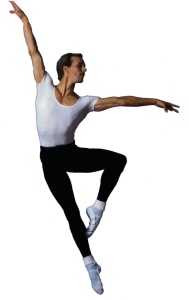
Wonderful dance posture — open chest, lengthened spine, ease in every line of the body.
How We Learn to Move
Learning movement, for all human beings, begins at birth. From an infant learning to roll from side to side in a crib, to crawling on hands and knees, to eventually balancing on two feet and walking — each stage involves the brain learning from trial and error, from every fall and every moment of strain, gradually refining movement toward greater ease and efficiency. The arms learn to flow; the muscles learn to act and react simultaneously. What seems effortless in an adult took enormous effort and repetition to acquire.
String playing is no different. The body learns technique the same way it learns to walk — through repetition, awareness, and the gradual refinement of movement patterns. The question is whether those patterns are being refined toward efficiency or toward compensated effort.
The Misconception: Slumping Is Just Part of Playing
A common misconception among string players is that sloping shoulders and poor posture simply come with the territory — an inevitable consequence of long rehearsals and hours of practice. But should slumping be part and parcel of playing? And is it possible that learning to open the chest and shoulders actually makes playing easier?
Dancers don’t slouch — not only because it’s less pleasing aesthetically, but because it’s not the most efficient way to use the body. An open chest and a lengthened spine create the conditions for free, powerful movement. A collapsed posture restricts it.
The Arching and Curling Motion Study
A simple motion study can help access the potential of the upper body and bring awareness to the range of motion available in the torso:
- Clasp the hands together and place them behind the neck at the nape, just below the skull.
- Curl the rib cage forward, allowing the abdominal muscles to press gently into the spine. Notice how the curve of the spine is emphasized and the chest closes inward.
- Now move into the opposite direction — arch the back and spine toward the back, lengthening the space between the vertebrae as you do so. Rather than simply stretching from the mid-back, focus on lengthening the entire torso. Think of lifting the heart to get a sense of the range of motion available and the ability to open the chest rather than cave it inward.
- Because the hands are behind the neck, the arms go along for the ride — this isolates the movement of the torso and makes it easier to feel the difference between a collapsed and an open upper body.
Repeat this several times, noticing the contrast between the curled and arched positions. The arched, open position — with a lengthened spine and lifted chest — is the foundation from which efficient bow arm technique becomes possible.
Why This Matters for Bow Technique
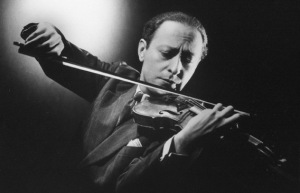
Now that’s posture — Jascha Heifetz demonstrating the open, upright frame that enables a free and powerful bow arm.
How the upper arm is oriented in relation to the bow determines whether a sound is pressed or spun like silk. When the upper body is slumped or torqued forward, the upper arm naturally follows — and in that position, the tendency is to press the bow into the string with vertical force rather than drawing sound through horizontal bow speed and arm weight. The result is a crushed, constricted tone that limits the resonance of the instrument.
An open, upright upper body creates the conditions for the upper arm to orient differently — with the potential to rotate slightly back from the shoulder, which acts as a natural counter to the tendency of the bow hand and forearm to swivel inward and lean weight onto the index finger.
A simple awareness exercise: hang the arm loosely at the side, then rotate the entire arm from the shoulder — first toward the back, then forward. Notice the range of motion available in the upper arm. This rotation toward the back is a movement that can be cultivated and brought into the bow stroke, creating a more balanced, free relationship between the arm and the bow.
Fatigue and lack of strength in certain muscle groups can make slumping feel inevitable. But simple awareness, combined with physical warm-up and the kind of postural attention that dancers develop as a matter of course, can make an enormous difference — not just in how playing looks, but in how it feels and sounds.
by Rozanna Weinberger
0 comments