
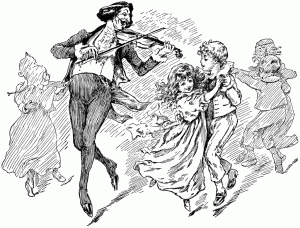
When playing becomes second nature — fluid, balanced, and effortless.
One of the biggest challenges for advancing string players is a comfortable left hand technique: the ability to move from note to note without excessive strain, with sound finger action and vibrato. Two teachers stand out as pioneers in illuminating a more natural use of the body — one rooted in the functionality of the skeletal system and muscles: Karen Tuttle and D.C. Dounis. Both emphasized balance, weight, and minimum effort. At the heart of their approach is a deceptively simple question: how easily or difficultly does the player move from one note to the next?
Dounis: Vertical and Horizontal Motion
Dounis stressed the development of both vertical and horizontal motion in the left hand. Effective finger action, he argued, is achieved with fingers nicely curved in relation to the fingerboard — the vertical dimension. Horizontal motion encompasses shifting and vibrato.
“The whole mechanism of shifting consists of knowing how to connect the positions. To master this technicality, the violinist should always remember that each finger must have as a guide another finger, and that the preceding finger is the most natural guide for every finger.”
— D.C. Dounis
With a systematic set of etudes designed to acquaint the fingers with patterns and distances on the fingerboard, the player cultivates a balanced feeling in the hand by allowing weight to transfer from one note to the next. The most crucial point: in the split second of transfer from one finger to the next, the hand must release and rebalance for the new note. Every position on the fingerboard requires a slightly different orientation of the hand so that weight can be transferred into the finger cleanly.

The Thumb and First Finger Trap
Many players make the mistake of thinking that maintaining a shifting guide finger means the hand should be oriented from the 1st finger. When this happens, a tense squeezing sensation develops between the thumb and 1st finger — and every left hand action becomes oriented around that squeeze. This is one of the most common sources of unnecessary tension in the left hand, and one of the most counterproductive habits a player can develop.
With a truly balanced left hand, the thumb is counterbalancing the fingers — not gripping against them. The right approach is to first establish what the fingers and hand need to do so the fingers are curved naturally in relation to the fingerboard. Once that is established, the thumb can adjust naturally to wherever it feels most comfortable in relation to the fingers.
Karen Tuttle: Release and Momentum

Karen Tuttle took Dounis’s principles a step further, emphasizing the release — the momentum — needed to move from one note to the next. She spoke of a release in the wrist that precedes any shift, comparable to the bending of the knees before a jump. Momentum is needed to propel the body forward; a simple release in the wrist provides that momentum in the left hand. Try to imagine jumping from point A to point B without first bending the knees — playing a string instrument without this wrist release is not so different.
Technique Is Brain Training
“The object of this work is to indicate a method of solving all of the problems of higher technique in both hands with the least possible expenditure of time and energy. The whole mechanism in shifting lies in knowing how to connect the positions.”
“The true technical training of the violinist is not merely a training of the arm and fingers but, principally, a training of the brain and memory. The fingers and the arm should obey perfectly the intention of the player in order to be able to perform any movement with complete mastery.”
— D.C. Dounis, The Artist’s Technique of Violin Playing
Many players think that playing well mainly involves training the arms and fingers. But Dounis is clear: technique is primarily a training of the brain and memory. The etudes dealing with shifting and fingerboard familiarity exist because the brain must assess the measurements — the distances between notes — so they can become automatic through repetition. It is a tactile experience that informs the brain, and vice versa.
Batting Average: Machine-Like Accuracy

A great musician relies on accuracy and consistency much like a great athlete — developed through repetition, awareness, and trust in the body’s learned intelligence.
The difference between machine-like exactness and the perfection a human being can achieve is important to understand. A machine is hard-wired to be exact; human beings are not. But through trial and error, we can develop the consistency needed for a highly reliable technique — one that, over time, can appear machine-like in its accuracy.
Repetition, Awareness, and Letting Go
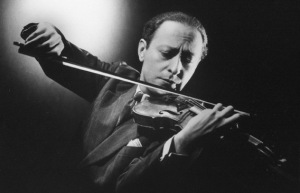
Jascha Heifetz — the result of deep kinesthetic learning, non-judgmental repetition, and a brain trained to trust itself.
Most string players believe that practicing a passage over and over again will lead to mastery. This is partly true — but the how matters enormously. Repetition is vital, but awareness is the key. The question is whether we judge each repetition as right or wrong, or whether we allow ourselves to cultivate a pure, non-judgmental awareness — so the brain can process each repetition and fine-tune our movements kinesthetically, on a level so subtle it defies our willful efforts to control the outcome.
Consider how an infant learns to walk. Through trial and error, a silent learning process unfolds with each fall and every wobble. But imagine teaching a child to walk the way we often teach violin technique — first move the foot, then the knee, then the hip. Such analysis quickly becomes an obstacle. Letting it happen and letting go are not passive goals — they are the result of trusting the brain to do what it has been trained to do. When you consider the many movements we perform daily with machine-like exactness — walking, running, catching — it becomes clear that humans are entirely capable of this kind of accuracy, if we can get out of our own way.
by Rozanna Weinberger
0 comments