
Have you ever noticed how many string players carry themselves with a curvature of the spine and sloping shoulders — even when not playing the instrument? It is remarkable how physical habits can develop unconsciously over years of practice. You would never see a dancer develop a slumping posture over time. Part of that is the physical conditioning their training demands, but it is also because learning to use the body optimally is considered a core skill for dancers. Why shouldn’t the same be true for string players?
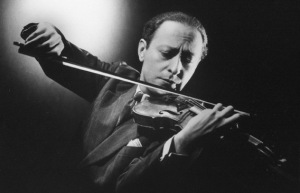
Jascha Heifetz — now that’s posture. An open, upright upper body that supports both the instrument and the bow arm.
The Slumping Shoulder Problem
In orchestras particularly, players often carry themselves with shoulders sloped inward — sometimes an effort to get closer to the music stand, sometimes the result of fatigue. The subtle workings of the upper body and abdominal muscles are only recently becoming understood in terms of their impact on string playing. While it is certainly possible to “get away” with poor posture, it ultimately determines whether difficult things — like playing the instrument — feel easy or feel like a struggle. This is often the difference between players considered “naturals” and everyone else: the naturals are, to a large degree, moving efficiently.
The Clavicle as a Natural Shelf

The clavicle forms a wonderful natural “shelf” for the instrument — but only when the upper body is sufficiently upright and supported.
Anything that makes it more difficult to counter the effects of gravity will inevitably lead to gripping the violin between the head and shoulder. Curving and jutting the shoulders forward — a typical stance for many string players — is actually the opposite of what a healthy relationship to the instrument requires. When the shoulders slope forward, the instrument wants to fall because of the angle created. The tendency to jut the shoulders forward is a compensation for a sense of insecurity in holding the violin.
By contrast, when the upper torso is sufficiently supported by the abdominal muscles, the upper body can effectively counter the weight of the violin and head. The shoulders are then free to rest atop the rib cage, where they can support the instrument far more efficiently. Many virtuosi hold their instrument quite high — and this is actually a more effective way to counter gravity, so long as the overall posture is not slumping. It makes possible the use of the clavicle as a perfect natural shelf for the violin.
The Role of the Core: What Pilates Has to Do With It

The core muscles — the same ones trained in Pilates — are essential for supporting the upper body and freeing the shoulders from the work of holding the instrument.
Most string players use the shoulders to replace activities that should be happening in other parts of the torso. The notion that we “hold ourselves up” by elevating the shoulders could be replaced by engaging the deeper core muscles — the same ones we are encouraged to use in Pilates. When these muscles are doing their job, the shoulders are far less likely to compensate by gripping upward.
Motion Study: The Chair Push-Up

Motion Study: Sit in an armchair or any chair with armrests. Press the palms of your hands against the armrests and begin to push yourself up out of the chair. Notice how the torso responds — elevating itself upward as the hands press down. The muscles that enable this elevation are the same muscles that should be engaged when playing the viola or violin. When these muscles are doing their job, the shoulders will not need to compensate by rising stiffly. And the improved posture will support a body angle far less likely to cause the instrument to fall.
Balance vs. Gripping: The Tightrope
What does it look and feel like to balance the instrument rather than grip it with the shoulder and head? Learning this process can feel vulnerable — because when the shoulders and head are no longer engaged in gripping the instrument, the player is left to discover just how little control they seem to have. But that is also precisely the point where genuine balance becomes possible, and where real self-discovery begins.
It takes time, patience, and observation. And lest the player confuse the use of a high shoulder rest with a balanced and genuinely secure position: unless the player masters the ability to respond to the ever-changing balancing act of holding the instrument — similar to an aerial artist on a tightrope — the shoulders will never be truly free. The goal is not to grip more securely, but to balance more skillfully.
by Rozanna Weinberger
0 σχόλια